Aichi (Aichi Prefecture)
R&D

Corrosion and Metals
Metals are often thought of as stable materials when they are finished, but in fact they are more stable when combined with other substances. This is confusing information for a moment, isn't it? Iron, for example, begins to seek oxygen and oxidize after it is refined. It is natural for it to become covered in rust and decay. This is called metal corrosion. This is the moment when I feel that nature is truly an amazing mechanism. However, this is not good for metal materials used in human society. The key is how to keep them from corroding and how to make them last longer. It is no exaggeration to say that modern society would not be able to do anything without metal, and if metal structures were to last only a few years, the very foundations of civilization would be shaken. Thus, various metals are refined and alloyed in human society, and new materials continue to be created.
What is weathering steel plate (hereinafter referred to as "Corten steel")?
Have you ever heard of Corten steel, a steel material known as weather resistant steel sheet? It is one of the most famous materials. It is a material that has succeeded in making the surface stable by daring it to rust, and by shutting off the core material and the outside air, it has tremendously prolonged its strength as a steel material. At first glance, it may look rusty, but the inside remains a brand new material. Rust is highly popular as a design feature. However, being a corrosive reaction, rust makes the metal itself brittle. It is fair to say that the advent of Corten steel played a major role in making these contradictory elements possible. It is one of the materials that we at Aichi Metal are familiar with. On the other hand, it has a drawback that it is difficult to reduce weight because it is naturally all metal and therefore quite heavy.
Design rust and natural rust
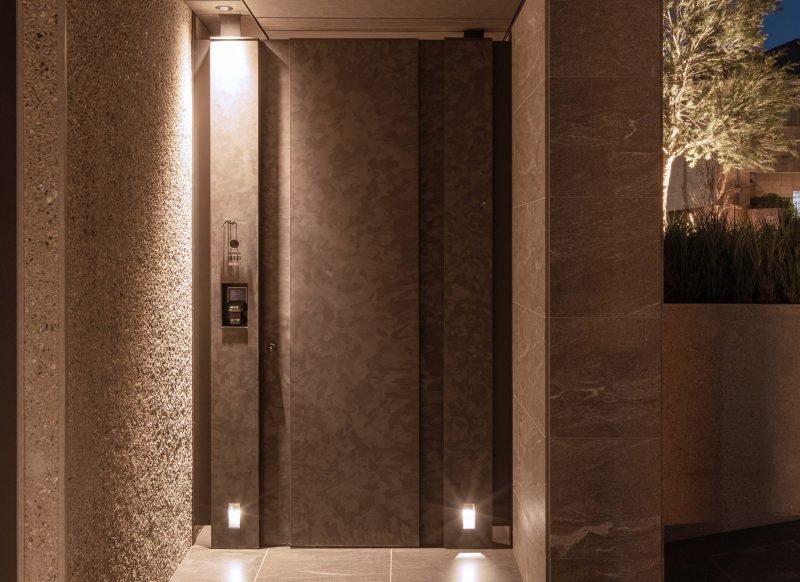
Using the VeroMetal technology at AICHI METAL, it is possible to create wooden boards with a metallic paint on the surface to create rust, or plastic can be used. To achieve strength, the surface can be treated with a honeycomb core. This allows us to make gates and doors that look like Corten steel but are lighter in weight. However, natural rust and design rust have very different finishes. Natural rust has an uneven and decadent appearance, whereas design rust has a uniform rust finish that gives the appearance of high quality in terms of color and texture. To successfully produce this design rust, and to make it appear on all or part of the surface, a technique is required. It is quite difficult to create a stable rust design.
Rust and design by thermal spraying technology
When we produce rust, we use metallic paints to target all kinds of materials. Therefore, we actively use polishing and thermal spraying techniques. First, depending on the surface finish, the rust will be extremely uneven. We will make adjustments to these, making the surface as flat as possible, or conversely, if the order is for an uneven surface, we will do so. Furthermore, if rust is produced on an exterior wall, it is greatly affected by the external environment, even if it is on an interior wall. If it rains, water will pass through the wall. At such times, we want to prevent the metal paint from peeling off the surface anyway. This is where thermal spraying technology is applied. By applying a thermal spray treatment to the base material to create a pear-shaped surface, and then applying the paint to the surface, we can create a finish that is tightly bonded to the base material and prevent most of the paint from peeling off. In this way, rust like Corten steel is stably produced on any material. Still, quality is still a ways off. We will continue to make improvements as we work to achieve a finish and design quality that makes it look as if it were a new material.