Nagoya City, Aichi Prefecture
Industrial company building
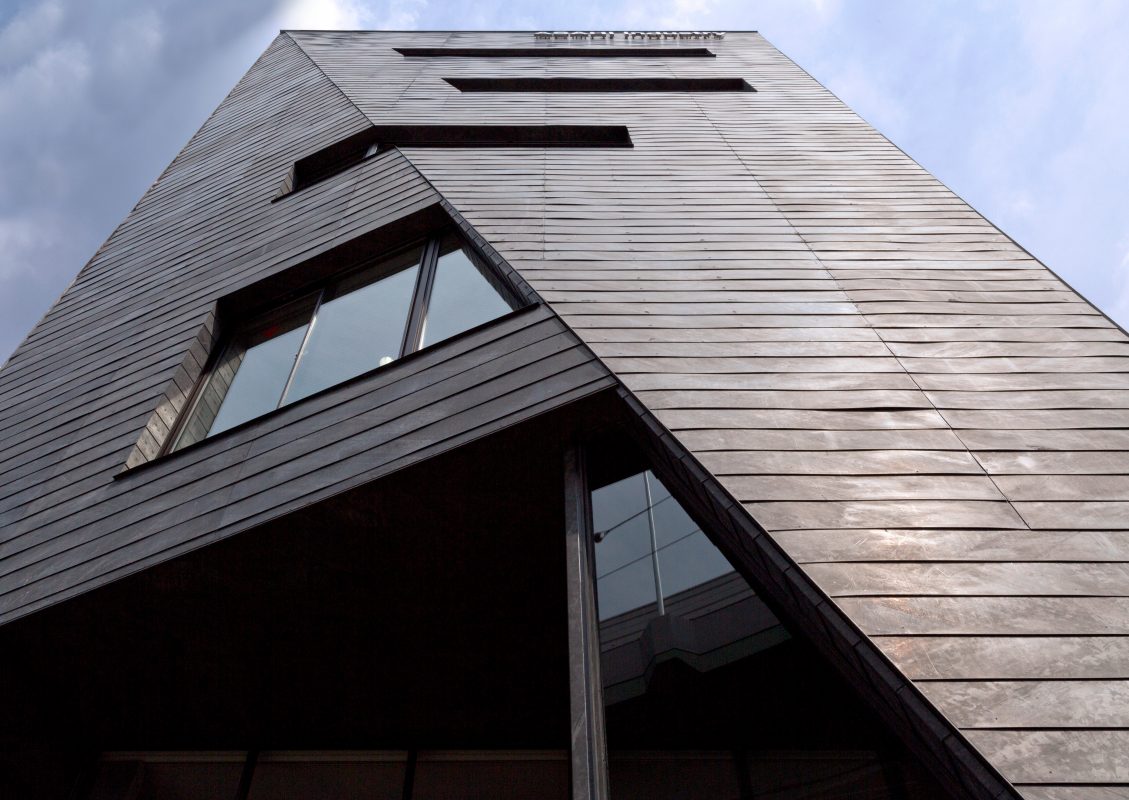
Phosphating steel is a very popular decorative treatment. Although it has become a relatively popular treatment, the most important aspect of this decoration is quality. One of the most common inquiries we receive these days is that there are more and more cases of phosphatized steel components becoming cloudy or discolored within a few months of installation. This is a case where some post-processing has not been applied after the phosphating treatment, or it is a separate treatment that only results in a phosphoric acid-like expression in the first place. It is difficult to tell the difference at the time of delivery, and it is necessary to work with a company that implements the process treatment with careful quality from the beginning. In this case, it was a tremendous challenge to attach these phosphate-treated materials to all the walls of the building. When attached to the surface of a building, the area exposed to wind and rain is naturally extraordinary. Furthermore, the volume of the materials would be unbelievable. On the other hand, the presence of the building as a whole will be dramatically enhanced, and the toughness of the building will be increased because the surface will be metallic. From the materials to the decorative treatment and all quality control, this was a rare project for AICHI METAL.
A collection of diverse metal expressions.
It is not only the walls. The interior materials for the entrance area and the iron frames for the exterior of the entrance, in which huge glass panels are inserted, were all processed and treated by AICHI METAL. It was a great honor for us to be involved in the metal treatment that played such an important role in the costume aspect of the building. Naturally, the responsibility was also heavy. The steel window surfaces required an extremely high degree of precision. Needless to say, the fitting of the glass surface is of extremely high importance, as the design is based on structural calculations that take into account earthquake resistance. In addition to the varied metallic expression created by the phosphate treatment on the walls, the black steel frames give a tightened look. The steel frame is treated with a matte coating, but since this too will be used for the exterior, a variety of know-how is incorporated into the finish to prevent paint from peeling off. After processing, we carefully inspect all the products for quality assurance since they are all shipped from our company.
It means to get the intention.
In projects such as buildings, it is rare for us to do on-site work. This is especially true for exterior walls. However, it is possible for us to conceive of the construction process. This means that we can imagine the entire process from design to construction, and take into account the intentions of the client. We consider this part of the process to be very important. On the other hand, it is always difficult, and sometimes even impractical, to achieve perfection. Communication is essential. How will it be constructed, how will it be finished, how long is the building expected to last, what is the level of earthquake resistance and robustness? We can only commit to a small percentage of all of this, but our ability to process and understand the project as a whole depends entirely on this kind of communication. It is important that we strive to build good relationships, but it is also important to clarify our position by not being afraid to communicate what we think. For us, that is what metalworking is all about.